
Background
Extended Producer Responsibility (EPR) is a regulation category designed to shift the cost and burden of managing a product's end-of-life — collection, sorting, recycling, and disposal — from taxpayers onto the companies that make and sell the product. The proliferation of recent regulations carries significant financial implications for companies, including large potential fees and reporting obligations.
The concept dates back to Germany's 1991 Packaging Ordinance. Europe's Waste Electrical and Electronic Equipment (WEEE) Directive, first adopted in 2003, became one of the first large-scale EPR programs, and for two decades EPR mostly applied to categories that were hazardous or expensive to handle: electronics, batteries, paint, and mattresses.
That's changed fast. Packaging — the largest source of municipal waste in most countries — is now the fastest-growing category of EPR regulation, and textiles are right behind it. In the United States, seven states have enacted comprehensive packaging EPR laws since 2021, and dozens of new bills are introduced every legislative session. Meanwhile in the European Union, the Packaging and Packaging Waste Regulation (PPWR) is advancing.
For companies that make, package, or sell physical goods, EPR is no longer a niche compliance issue, but one that carries significant operational reporting and financial implications in the near term.
Key Takeaways
- EPR regulations make companies selling physical goods responsible for the entire life cycle of packaging.
- EPR has expanded well beyond its original hazardous-waste focus and now covers packaging, textiles, electronics, and batteries across US states and countries.
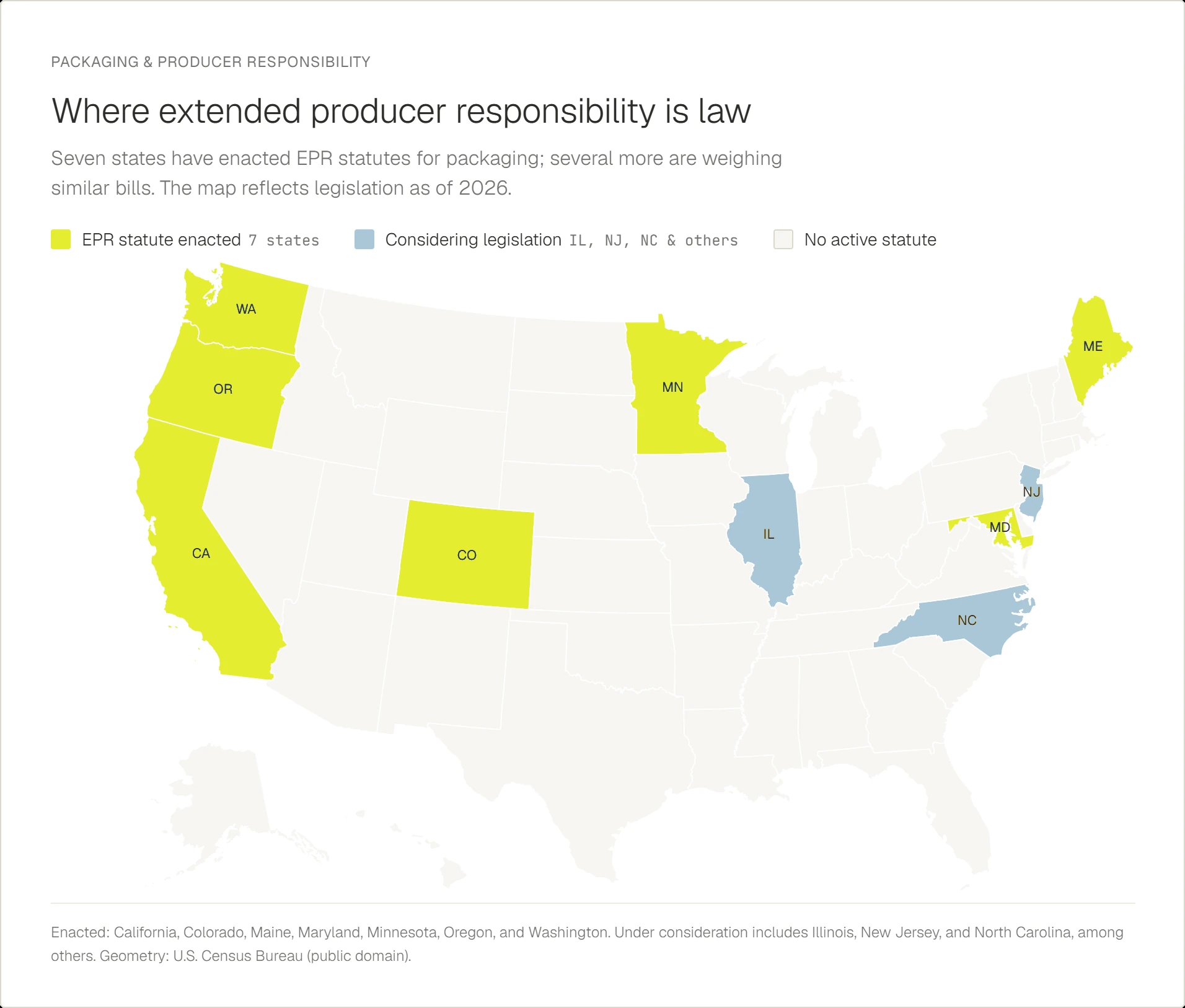
- Seven US states — California, Colorado, Maine, Maryland, Minnesota, Oregon, and Washington — have enacted comprehensive packaging EPR laws, with more states actively considering bills.
- 2026 is a pivotal enforcement year: Oregon has moved into active enforcement, six states require annual supply reporting by May 31, 2026, and the EU's PPWR becomes directly applicable.
- Proposed penalties for non-compliance are material — up to $50,000 per day — and several states now publicly list non-compliant producers.
- Companies that have already built rigorous data infrastructure for GHG emissions or other sustainability disclosures (CDP, CSRD, SB 253) have a head start on the data discipline EPR requires.
Who Must Comply
Most EPR laws define a "producer" as the brand owner, or the first company to import or distribute a covered product or its packaging, into a given market. In practice, this typically means:
- Consumer packaged goods (CPG) companies, for the packaging around their products.
- Apparel and textile brands and retailers, under laws like California's SB 707.
- Electronics and battery manufacturers, under longer-standing programs like the EU's WEEE Directive and Battery Regulation.
- Online retailers and marketplaces, which several states now explicitly capture as "producers" for packaging they ship directly to consumers.
Thresholds vary by state and law. Most packaging EPR laws exempt small businesses below a certain revenue or tonnage threshold, but the bar is often lower than companies expect — California's SB 54, for example, applies to any producer that sells, distributes, or imports covered packaging into the state, with only narrow small-business carve-outs. Companies should not assume they're exempt without checking the specific thresholds in each jurisdiction where they sell.
EPR regulations are complicated, various, and quickly evolving. Make sure you consult with legal counsel on your organization's compliance obligations.
Why This Matters for Your Business
Unlike CDP or similar voluntary disclosure frameworks, EPR compliance isn't optional — but that doesn't mean there's no strategic upside to getting ahead of it. Most EPR programs charge producers less for packaging and materials that are recyclable, reusable, or made with recycled content, and more for materials that are hard to recycle. Companies that redesign packaging proactively can materially reduce their ongoing compliance costs, not just avoid penalties.
Getting ahead of EPR also means avoiding the scramble that comes with fragmented, state-by-state reporting deadlines. Producers already selling into multiple states or countries face a patchwork of registration dates, reporting formats, and fee schedules — and the data burden compounds with each new jurisdiction that passes a law. Companies that build a single, centralized system for tracking packaging and material data across their business — rather than responding to each law one at a time — put themselves in a much stronger position as the regulatory map keeps filling in.
What's Required, Summary by Jurisdiction
US State Packaging EPR Laws
California, Colorado, Maine, Maryland, Minnesota, Oregon, and Washington have all enacted comprehensive packaging EPR laws, though they're at different stages of implementation:
- Oregon was first to reach full implementation, with its program starting July 1, 2025. Producers must register with the state's producer responsibility organization (PRO), report packaging data, and pay fees; Oregon has since moved into active enforcement.
- California's SB 54 (the Plastic Pollution Prevention and Packaging Producer Responsibility Act) sets some of the most aggressive targets in the country: producers must collectively reach 30% recycling by 2028, 40% by 2030, and 65% by 2032, alongside source-reduction targets of 10% by 2027, 20% by 2030, and 25% by 2032 for single-use plastic packaging and food service ware, compared to 2023 volumes. Covered companies must join a PRO by January 1, 2027.
- Maryland, Minnesota, Colorado, Maine, and Washington are each at different implementation stages, with registration, reporting, and PRO fee timelines staggered out through the early 2030s. Minnesota, for example, doesn't expect substantive packaging requirements to take effect until 2032, while Washington requires producers to join a PRO in 2026 as rulemaking continues.
Six of the seven states require an annual supply report by May 31, 2026, covering the weight and material types of packaging each producer distributed into the state in 2025 — the first real data test for many companies.
US Textile EPR: California's SB 707
California's Responsible Textile Recovery Act (SB 707) made it the first US state with a textile-specific EPR law. In February 2026, CalRecycle selected Landbell USA as the state's PRO, and all producers of covered apparel and textile articles must join the PRO by July 1, 2026. Other states are watching closely, and similar bills could follow.
EU Packaging and Packaging Waste Regulation (PPWR)
The EU's Packaging and Packaging Waste Regulation (2025/40) entered into force in February 2025 and becomes directly applicable across all member states on August 12, 2026. Key provisions taking effect in August 2026 include:
- Strict PFAS limits in food-contact packaging.
- Requirements for active reuse systems.
- A requirement that hospitality businesses (HORECA) let customers use their own reusable containers at no extra charge.
Producers bear EPR fees modulated by recyclability, recycled content, and reusability. Additional milestones follow in 2028 (harmonized labeling) and 2030 (design-for-recyclability standards, minimum recycled content thresholds, and further EPR fee expansions).
EU Textile EPR
The EU's revised Waste Framework Directive, in force since October 2025, requires every member state to establish its own national textile EPR scheme. France has run one since 2007, the Netherlands since 2023, and Latvia since 2024, and the rest of the bloc is now required to catch up.
Electronics and Batteries: The Established Precedent
Electronics and batteries remain the longest-running EPR categories and are worth tracking alongside newer packaging and textile obligations. The EU's WEEE Directive has applied since 2003, and the EU Battery Regulation, in force since 2023, is phasing in new extended producer responsibility obligations for battery collection and recycling. In the US, EPR laws for electronics and batteries exist in a patchwork of states and are frequently the model legislators point to when drafting newer packaging and textile bills.
Penalties for Non-Compliance
Enforcement is no longer theoretical. Penalty structures vary significantly by state, but all are designed to make non-compliance more expensive than participation:
- California: up to $50,000 per day
- Oregon: up to $25,000 per day for failing to register or join a PRO
- Maine: $100 to $10,000 per day
- Maryland: generally $5,000 to up to $20,000 per violation
- Washington: $1,000 for a first violation; up to $10,000 per violation
- Minnesota: $100,000 per day for successive violations
Beyond fines, non-compliant producers can be publicly listed, referred to state environmental agencies, or face sales restrictions in individual states — all real risks for a consumer-facing brand.
Key 2026 Dates
- May 31, 2026: Annual supply reporting deadline for most US states with active packaging EPR programs, covering 2025 packaging data.
- July 1, 2026: Deadline for California textile producers to join the state's PRO under SB 707.
- August 12, 2026: EU Packaging and Packaging Waste Regulation becomes directly applicable, triggering PFAS restrictions and reuse-system requirements.
- January 1, 2027: California producers must join a PRO.
- 2028–2032: Staggered rollout of remaining state requirements (Maryland, Minnesota, Colorado) and EU PPWR design and labeling milestones.
How Gravity Can Help
EPR reporting asks a different question than a carbon inventory — material weights and recyclability rather than tons of CO2e — but it demands the same underlying discipline: centralized, audit-ready data that can be traced back to its source and reused across multiple reporting obligations. Many of the same companies now registering for packaging or textile EPR are also managing SB 253, CSRD, or CDP disclosures, often with the same sustainability or compliance team responsible for all of it.
That's the core problem Gravity helps solve. Gravity's platform gives companies a single source of truth for sustainability data — with supporting evidence attached to every data point and full data logs for audit readiness — that can be mapped across multiple reporting frameworks rather than rebuilt from scratch each time a new regulation lands. As EPR obligations expand into new states and product categories, companies with that kind of data infrastructure already in place will be far better positioned to adapt than those still managing compliance framework by framework, spreadsheet by spreadsheet.
If your team is trying to figure out how EPR fits alongside your existing sustainability reporting obligations, reach out to Gravity's policy team to talk through how to build a data strategy that scales as new requirements come online.
Frequently Asked Questions
What is Extended Producer Responsibility?
EPR is a policy approach that makes producers — rather than municipalities or taxpayers — responsible for managing their products at end-of-life, including collection, recycling, and disposal.
Which US states currently have packaging EPR laws?
California, Colorado, Maine, Maryland, Minnesota, Oregon, and Washington have all enacted comprehensive packaging EPR laws, at varying stages of implementation.
Does EPR apply to my company if I don't manufacture packaging myself?
Often, yes. Most laws define "producer" as the brand owner or first company to distribute a product or its packaging into a state — not just the manufacturer of the packaging itself.
What's the difference between EPR and frameworks like CSRD or SB 253?
CSRD and SB 253 are sustainability disclosure requirements, focused primarily on reporting emissions and other ESG metrics. EPR is an operational compliance regime: producers must register, report material-level data, and pay fees tied to the packaging or products they place in the market, funding actual collection and recycling infrastructure.
What happens if my company doesn't comply?
Penalties vary by state but can reach tens of thousands of dollars per day, and several states publicly list non-compliant producers and refer cases to environmental regulators.
Is EPR only about packaging?
No. While packaging is the fastest-growing category, EPR also applies to textiles, electronics, batteries, and other product categories, with new categories and jurisdictions added regularly.